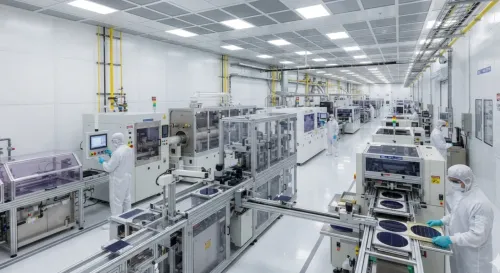

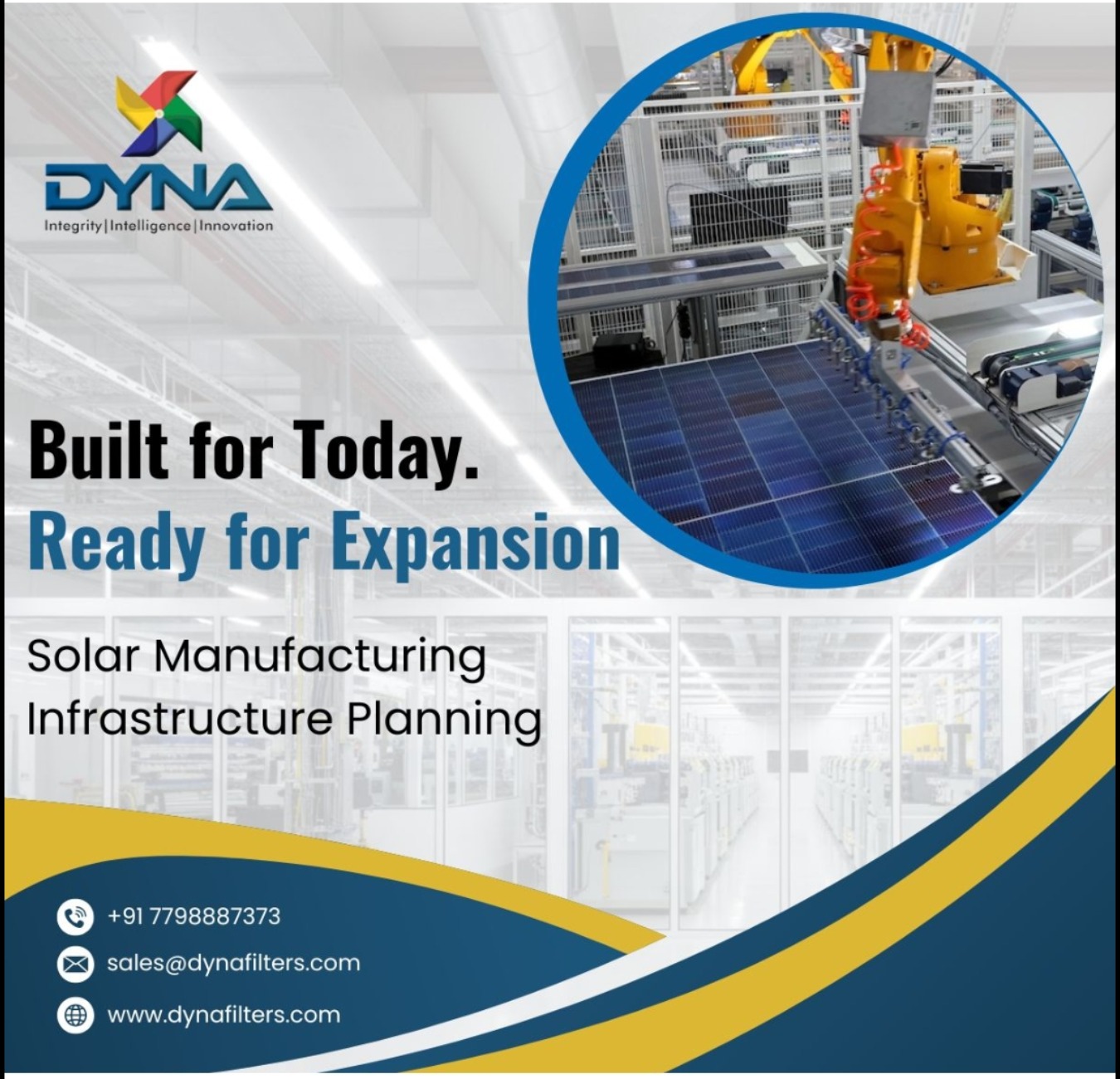
In the solar manufacturing industry, the gap between Nameplate Capacity (the theoretical maximum) and Actual Output (real-world production) is a critical metric for operational efficiency.
Cleanroom is very important to increase this operational efficiency and reduce the Cell-to-Module (CTM) Losses.
Dyna, while engineering a cleanroom for solar cell manufacturing lines, follows the points mentioned below to achieve the same.
1. Particle Control vs. Automation
Unlike pharma, solar lines are 100% automated with
high-speed robotics.
- The
Challenge: Moving parts generate significant carbon/metallic dust.
- Design
Point: Use Localized ISO Class 5 (Class 100) "mini-environments"
over the wafer handling areas, while the rest of the room can be ISO
Class 7 or 8.
- Floor
Loading: High-speed automated guided vehicles (AGVs) require
ultra-level, anti-static (ESD) flooring to prevent vibration-induced
breakage of thin wafers.
2. Precise Humidity Control (The "Dry"
Requirement)
- The
Challenge: Solar cells involve complex chemical layers. In HJT
manufacturing, the TCO (Transparent Conductive Oxide) and Amorphous
Silicon layers are highly sensitive to moisture.
- Design
Point: Maintain Relative Humidity (RH) at 45% ± 5%. If RH
is too high, it leads to oxidation; if too low, ESD (Electrostatic
Discharge) will destroy the cell's circuitry.
3. Specialized Exhaust & Chemical Safety
Solar manufacturing is "chemically aggressive."
- Acid/Alkali
Exhaust: Texturing and etching stages use HF (Hydrofluoric Acid) and
KOH. Exhaust ducts must be PP-FR (Polypropylene Fire Retardant) or
stainless steel with specialized coatings.
- Silane
(SiH4) Safety: PECVD tools use Silane, which is pyrophoric (ignites on
contact with air). The cleanroom design must include explosion-proof
zones, dedicated gas bunkers, and high-frequency air changes in gas
cabinets.
4. High-Purity Water (DI Water) Integration
- The
Challenge: Wafers are rinsed after every chemical stage. Any metallic
impurity in the water will "poison" the cell's efficiency.
- Design
Point: The cleanroom must accommodate a massive Deionized (DI)
Water loop. The piping (usually PVDF) must be designed to prevent
"dead legs" where bacteria can grow, as biological films are as
damaging as dust.
5. Vibrational & Electromagnetic Isolation
- The
Challenge: Photolithography and laser dicing tools operate at micron
scales.
- Design
Point: Structural isolation of the floor slabs for laser rooms to
prevent "blurring" of the patterns caused by heavy HVAC chillers
or nearby heavy traffic.
6. Summary of Standards by Zone
|
Zone |
ISO Class |
Critical
Parameter |
|
Wafer
Loading/Unloading |
ISO 5 / 6 |
Low ESD
& Dust |
|
Diffusion
/ PECVD |
ISO 7 |
Gas Exhaust
& Heat Load |
|
Wet Bench
/ Etching |
ISO 8 |
Acid-Resistant
Surfaces |
|
Screen
Printing |
ISO 7 |
Temperature
Stability (for Paste Viscosity) |
For comprehensive solutions, contact us at sales@dynafilters.com or call +917798887373