

The solar energy industry relies on advanced manufacturing processes to produce high-performance photovoltaic (PV) cells and modules. Alongside production equipment, the manufacturing environment plays an important role in controlling contamination, maintaining process conditions and supporting consistent product quality.
A solar cell manufacturing cleanroom is a controlled environment designed to limit airborne particles and maintain specified environmental conditions where required by the manufacturing process.
From silicon wafer processing and surface treatment to cell fabrication and module assembly, appropriate environmental controls can help protect contamination-sensitive materials and processes.
For companies planning or expanding solar manufacturing facilities, understanding cleanroom design, HVAC systems, air filtration and process requirements is an important part of facility planning.
What Is a Cleanroom in Solar Cell Manufacturing?
A cleanroom is a specially designed space in which airborne particle concentration is controlled according to defined requirements. Depending on the application, other parameters such as temperature, relative humidity, room pressure and airflow may also need to be controlled.
In solar cell manufacturing, these controls can be particularly relevant to processes involving silicon wafers, surface cleaning, passivation, thin-film deposition and other contamination-sensitive operations.
The required cleanliness level depends on the cell technology, manufacturing process, equipment specifications and quality objectives. Not every area of a solar manufacturing facility requires the same cleanroom classification.
Why Are Cleanrooms Important in Solar Cell Manufacturing?
Appropriate environmental control supports manufacturing consistency and helps protect sensitive materials during production.
1. Contamination Control
Airborne particles and unwanted residues can affect exposed wafer surfaces and subsequent processing operations. Suitable filtration, cleaning protocols, material handling and environmental controls help reduce contamination risks.
2. Temperature and Humidity Management
Some manufacturing processes require temperature and humidity to remain within specified operating ranges. An appropriately designed HVAC system helps maintain these conditions according to process requirements.
3. Process Consistency
Controlled environmental conditions can help reduce unwanted variability in contamination-sensitive production steps and support repeatable manufacturing operations.
4. Product Quality
Clean handling and appropriate process controls help protect wafers, cell surfaces and other sensitive components throughout production.
5. Controlled Personnel and Material Movement
Personnel, incoming materials, packaging and equipment can introduce contamination. Facility layouts should therefore consider movement routes, access controls, gowning requirements and material transfer arrangements where applicable.
Where Are Cleanrooms Used in Solar Cell Manufacturing?
Solar cell manufacturing involves multiple stages, from raw silicon processing and wafer production to photovoltaic cell fabrication, testing and module assembly. Environmental requirements vary across these stages, and only selected operations may require a classified cleanroom.
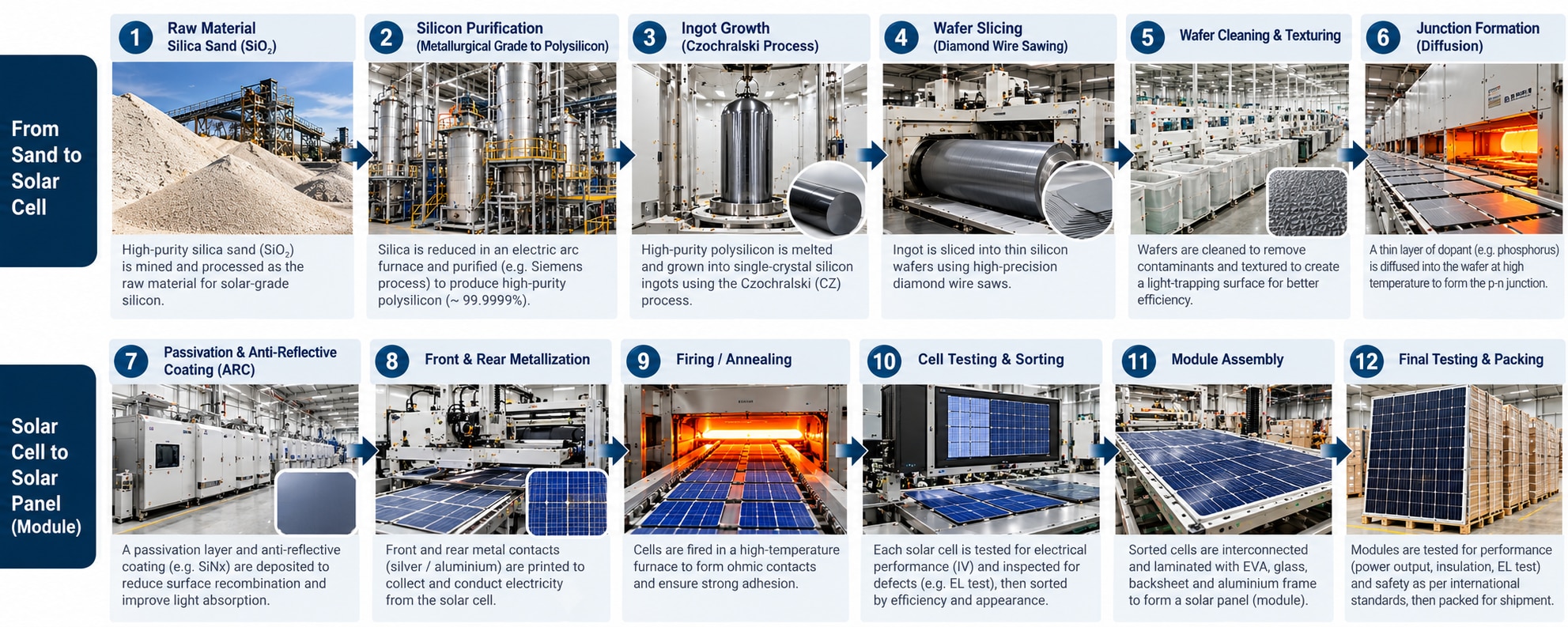
Wafer Cleaning and Texturing
Silicon wafers are cleaned and treated to prepare their surfaces for subsequent manufacturing steps. Contamination control is important because surface condition can influence later processing.
Junction Formation and Cell Processing
The semiconductor structure is formed using process-specific techniques. Environmental requirements depend on the cell architecture, manufacturing equipment and process specifications.
Passivation and Surface Coating
Surface passivation and coating processes require suitable material and process control. Contamination management can be important for protecting sensitive surfaces and interfaces.
Thin-Film Deposition and Advanced Cell Technologies
Some manufacturing processes involve depositing thin layers or creating specialised surface structures. These processes may require carefully controlled environmental and material-handling conditions.
Metallization and Thermal Processing
Electrical contacts are formed and processed according to the selected cell technology. Appropriate handling, cleanliness and equipment control support consistent production.
Cell Testing and Sorting
Finished cells are measured, inspected and classified. Clean handling helps protect cells during inspection and transfer to module assembly.
Solar Module Assembly
Solar cells are interconnected and assembled with glass, encapsulant and other module components. Contamination control and a suitable assembly environment can help protect product quality. The required cleanliness level depends on the manufacturing operation.
How Does a Solar Manufacturing Cleanroom HVAC System Work?
HVAC stands for heating, ventilation and air conditioning. In a cleanroom, the HVAC system does more than provide thermal comfort: it helps maintain the environmental conditions required for manufacturing.
A typical design may include the following elements.
1. Air Conditioning and Treatment
Incoming and recirculated air are treated to maintain the required temperature, humidity and other specified conditions.
2. Air Filtration
Pre-filters, fine filters and HEPA or ULPA filters may be selected according to the required air cleanliness and system design. Final filtration requirements depend on the process and the cleanroom specification.
3. Controlled Air Distribution
Air supply, circulation and return arrangements are designed to achieve suitable airflow patterns and reduce the accumulation of airborne contaminants in critical areas.
4. Pressure Control
Differential pressure between rooms may be used to control the movement of air between different areas. The pressure strategy must account for contamination control, chemical processes, exhaust systems and worker safety.
5. Environmental Monitoring
Depending on the application, monitoring may include airborne particle levels, temperature, relative humidity, differential pressure and other specified parameters.
The final HVAC design should be based on process requirements, equipment heat loads, people and material movement, utility requirements and applicable engineering standards.
Key Components of a Solar Cell Cleanroom
A cleanroom project may involve several coordinated facility elements, depending on the agreed scope.
Cleanroom panels and ceiling systems: Form the room enclosure and provide suitable internal surfaces.
HVAC systems: Support required temperature, humidity, ventilation and airflow conditions.
Air filtration: Controls airborne particles through appropriately selected filtration stages.
Air distribution systems: Deliver and return air according to the design.
Lighting: Provides suitable illumination for manufacturing, inspection and maintenance.
Personnel and material access: Supports controlled entry, gowning and movement of materials.
Utility coordination: Accommodates the services required by production equipment.
Monitoring and controls: Help verify that specified environmental conditions are maintained.
Chemical processing, process exhaust, specialty gases and other production utilities may require separate specialist design, safety systems and engineering coordination.
Cleanroom Requirements for PERC, TOPCon and HJT Solar Cells
Solar cell technologies use different structures and manufacturing processes. Their facility requirements should therefore be established individually.
PERC solar cells: Use a passivated rear-side structure. Facility requirements depend on the equipment and processes used for wafer preparation, diffusion, coating and metallization.
TOPCon solar cells: Use a tunnel oxide and passivated contact structure. The production process includes technology-specific steps that may require carefully controlled surfaces, materials and deposition conditions.
HJT solar cells: Combine crystalline silicon with thin semiconductor layers. Selected processes can be sensitive to contamination and require suitable environmental and material-handling controls.
A cleanroom specification should not be based on cell technology alone. The final requirements must also consider the manufacturing equipment, process chemistry, production capacity, quality objectives and applicable standards.
What Should Be Considered When Planning a Solar Manufacturing Facility?
Before designing a cleanroom or HVAC system, project teams should evaluate the following:
Manufacturing technology: Identify whether the facility will produce PERC, TOPCon, HJT or another cell type, or focus on module assembly.
Production capacity: Establish the intended output and production flow.
Equipment layout: Coordinate cleanroom and HVAC design with machine dimensions, access and maintenance requirements.
Environmental requirements: Define the required particle cleanliness, temperature, humidity and pressure conditions for each area.
Utilities and exhaust: Identify the services and process exhaust requirements of the production equipment.
Material and personnel flow: Plan movement routes to reduce unnecessary cross-traffic and contamination risks.
Quality and safety requirements: Consider the applicable process, building, electrical, fire and occupational safety requirements.
Future expansion: Consider maintenance access, additional equipment and potential production capacity changes.
Early coordination between the process equipment supplier and facility engineering team helps establish a practical, process-specific design.
How DYNA EPC Supports Cleanroom and Facility Engineering
DYNA EPC, a wholly owned subsidiary of Dyna Filters Pvt. Ltd., focuses on turnkey cleanroom subcontracting and related engineering solutions for industrial manufacturing environments.
Depending on project requirements and the agreed scope, relevant services may include:
Cleanroom planning and layout coordination.
HVAC system planning and environmental control.
Air filtration solutions and associated system coordination.
Cleanroom panels and related facility components.
Coordination of utilities and equipment interfaces.
Installation and commissioning coordination.
For solar manufacturing projects, facility requirements should be developed around the selected production process and the client's technical specifications. The required scope and deliverables should be confirmed for each project.
Planning a Solar Manufacturing Facility?
Whether you are evaluating a new facility or planning an expansion, defining the right cleanroom and HVAC requirements early can support better coordination between manufacturing equipment and building infrastructure.
Contact DYNA EPC to discuss cleanroom and related facility engineering requirements for your industrial manufacturing project.
Website: https://www.dyna-epc.com/
Contact DYNA EPC: https://www.dynaepc.com/mapview/18-4990978/73-9189963
Frequently Asked Questions
1. What is a solar cell manufacturing cleanroom?
A solar cell manufacturing cleanroom is a controlled environment designed to limit airborne particles and maintain specified environmental conditions where required by solar cell production processes.
2. Why are cleanrooms used in solar cell manufacturing?
Cleanrooms help control contamination in sensitive manufacturing operations. Suitable cleanliness and environmental controls can support process consistency and protect wafer surfaces, coatings and other sensitive components.
3. Does every solar cell manufacturing stage require a cleanroom?
No. Requirements depend on the manufacturing process, technology and equipment. Some stages need carefully controlled environments, while others may be supported by appropriate industrial environmental and cleanliness controls without requiring the same cleanroom classification.
4. What HVAC systems are required for a solar manufacturing cleanroom?
The system depends on required temperature, humidity, cleanliness, airflow, equipment heat loads, ventilation and pressure relationships. It may include multiple filtration stages, controlled air distribution, recirculation and monitoring systems where specified.
5. What filtration is used in solar cell cleanrooms?
Filtration may include pre-filters, fine filters and HEPA or ULPA filters, depending on the required cleanliness level and process. Filter type and performance should be selected through engineering design rather than assumed to be identical for every room.
6. Are TOPCon and HJT solar cell factories required to have cleanrooms?
Selected TOPCon and HJT manufacturing operations may require tightly controlled environments because of their process and contamination sensitivities. The required cleanroom classification and environmental conditions must be established from the equipment and process specifications.
7. What factors determine the cost of a solar manufacturing cleanroom?
Costs depend on the required area, cleanliness classification, building conditions, HVAC capacity, filtration, environmental controls, utilities, equipment interfaces, materials and project scope. A project-specific design and scope definition are necessary before a reliable cost estimate can be developed.
8. Can an existing industrial building be converted into a solar manufacturing cleanroom?
Potentially, subject to assessment. The building structure, floor loading, equipment layout, available utilities, ventilation, process exhaust, fire and life-safety provisions, and environmental requirements must be reviewed before confirming suitability.
9. What information is needed to plan a solar cleanroom project?
Useful initial information includes the manufacturing technology, planned production capacity, equipment list, building drawings, required cleanliness levels, environmental parameters, utility requirements and project timeline.
10. How can DYNA EPC help with a solar manufacturing cleanroom project?
DYNA EPC focuses on turnkey cleanroom subcontracting and related engineering solutions. The proposed scope can be discussed against the client's facility requirements and confirmed project deliverables.
Conclusion
Solar cell manufacturing requires more than production equipment. Appropriate facility planning, contamination control, HVAC design, filtration and coordination with process utilities all contribute to creating an environment suited to the manufacturing operation.
By defining these requirements early, project teams can develop facility solutions aligned with their selected technology and production objectives.
For cleanroom and related facility engineering enquiries, contact our team. Contact Us | DYNA, Pune, India
