
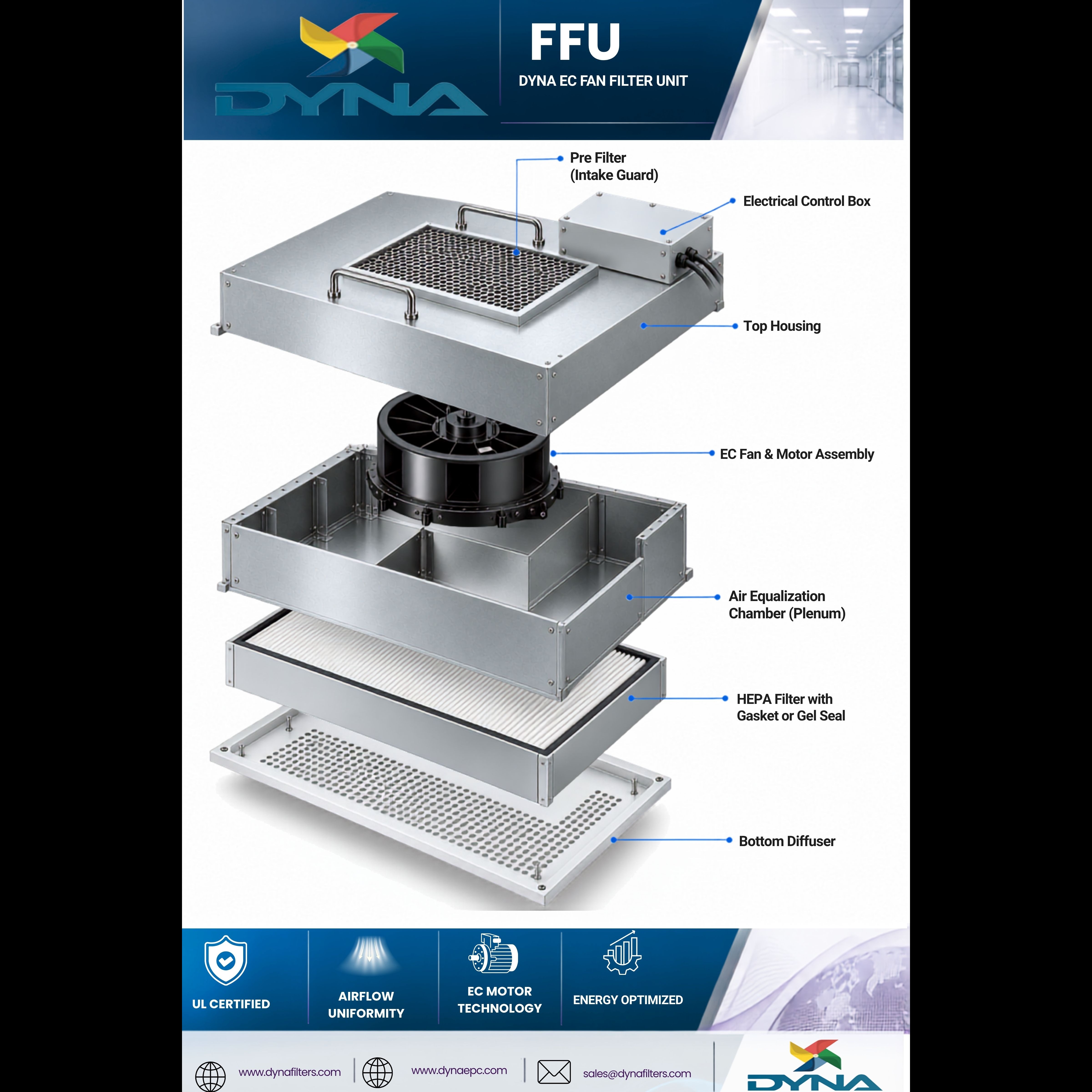
Fan Filter Units
DYNA manufactures UL Certified Fan Filter Units (FFUs) for cleanroom environments requiring controlled airflow, particulate filtration, and contamination management.
A Fan Filter Unit combines a motorized fan assembly with HEPA or ULPA filtration inside a compact ceiling-mounted module. The system supplies filtered air directly into the cleanroom while supporting airflow uniformity and pressure stability across contamination-sensitive production areas.
Unlike centralized ducted airflow systems, FFUs allow localized airflow control inside specific cleanroom zones. This helps support modular cleanroom layouts, phased production expansion, process segregation, and airflow balancing requirements.
DYNA FFUs are designed for cleanroom applications where airflow consistency, filtration integrity, operational reliability, and compliance readiness directly influence manufacturing conditions.
Key Features of Dyna Fan Filter Units (FFUs)
Superior Air Filtration
Equipped with HEPA/ULPA filters to achieve up to 99.99% efficiency, ensuring clean, particle-free air.
Energy-Efficient Performance
Optimized power consumption reduces operational costs while maintaining superior airflow.
Ultra-Quiet Operation
Low noise levels enhance comfort and minimize disturbances in controlled environments.
Compact & Space-Saving Design
Ideal for installations where space constraints are a concern.
Customizable Solutions
Available in multiple sizes and airflow configurations to suit specific needs.
FFU Product Specifications
| Feature | Specification |
|---|---|
| Airflow Capacity | XX – XX CFM |
| Filter Type | HEPA/ULPA |
| Efficiency | Up to 99.99% |
| Power Consumption | XX Watts |
| Noise Level | XX dB |
| Material | High-grade steel/aluminium |
| Dimensions | Customizable |
Applications of Dyna Fan Filter Units
Dyna FFUs are used across various industries that require ultra-clean environments.
- Cleanrooms & Controlled Environments – Ensuring air purity in medical and pharmaceutical settings.
- Laboratories & Research Facilities – Maintaining contamination-free spaces for testing and experimentation.
- Microprocessor & Semiconductor Assembly – Protecting sensitive components from airborne particles.
- Pharmaceutical & Medical Manufacturing – Supporting compliance with strict hygiene standards.
- Aerospace & Optical Industries – Essential for precision manufacturing processes.
Why Fan Filter Units Matter in Modern Cleanrooms
Cleanroom performance depends on how airborne particles move inside the occupied space. Filtration efficiency alone does not determine cleanliness.
Airflow velocity, airflow direction, pressure relationships, equipment heat loads, and return air behavior all affect contamination control.
Fan Filter Units help create controlled vertical airflow directly above process-critical areas. This localized airflow strategy helps reduce airborne particle accumulation generated during production activities, operator movement, material handling, and equipment interaction.
In pharmaceutical environments, FFUs support contamination-controlled manufacturing areas such as sterile filling lines, formulation rooms, microbiology laboratories, and aseptic processing zones.
In semiconductor and electronics manufacturing, stable airflow becomes critical because microscopic airborne particles can affect process consistency and production yield.
Compared to fully centralized airflow systems, FFUs provide greater flexibility during:
- Cleanroom expansion
- Equipment relocation
- Process modifications
- Production scaling
- Airflow zoning adjustments
Modern EC motor FFUs also support better airflow control and lower operational energy consumption when integrated correctly into the cleanroom design.
How Fan Filter Units Work Inside a Cleanroom
A Fan Filter Unit continuously draws air from the ceiling plenum or the surrounding environment into the fan section.
The air then passes through HEPA or ULPA filtration before being discharged downward into the cleanroom as controlled airflow.
The objective is not simple air circulation.
The objective is controlled contamination movement.
The filtered airflow helps dilute and remove airborne particles generated from:
- Personnel movement
- Equipment operation
- Packaging activity
- Material transfer
- Production processes
Proper FFU integration helps maintain:
- Airflow uniformity
- Pressure differentials
- Contamination control
- Air changes per hour
- ISO cleanroom classifications
Actual FFU performance depends on multiple engineering conditions, including:
- Ceiling grid design
- Airflow velocity stability
- Return air path positioning
- Equipment heat generation
- Room occupancy
- Filter loading behaviour
Even high-efficiency filters can underperform if airflow distribution inside the cleanroom becomes unstable.
How to Select the Right Fan Filter Unit for Your Cleanroom
Selecting the right Fan Filter Unit involves more than matching airflow capacity or filter efficiency. Cleanroom classification, process sensitivity, ceiling layout, occupancy levels, and energy consumption all influence FFU performance.
A Fan Filter Unit that performs well in an ISO 8 pharmaceutical cleanroom may not meet the airflow and cleanliness requirements of an ISO 5 semiconductor environment.
The selection process should consider:
- Cleanroom classification
- Required air changes per hour
- HEPA or ULPA filtration requirements
- Ceiling coverage
- Operating noise levels
- Long-term maintenance considerations
Proper FFU selection helps maintain consistent cleanroom performance while optimising energy consumption and operational costs.
| Application | Recommended FFU Type |
|---|---|
| Pharmaceutical Manufacturing | HEPA Fan Filter Unit |
| Biotechnology Laboratories | HEPA Fan Filter Unit |
| Medical Device Manufacturing | HEPA Fan Filter Unit |
| Semiconductor Manufacturing | ULPA Fan Filter Unit |
| Electronics Assembly | ULPA Fan Filter Unit |
| Cell & Gene Therapy Facilities | ULPA Fan Filter Unit |
How Many Fan Filter Units Does a Cleanroom Need?
The number of Fan Filter Units required in a cleanroom depends on the target cleanliness level, room dimensions, air change requirements, process equipment, and occupancy patterns.
Determining FFU quantity solely based on room area often leads to underperforming or overdesigned cleanrooms.
Cleanrooms operating at ISO 5 require substantially higher ceiling coverage and airflow than ISO 8 environments.
Process heat loads, equipment placement, and airflow patterns must also be considered to achieve uniform contamination control.
| Cleanroom Classification | Typical FFU Ceiling Coverage |
|---|---|
| ISO 8 | 15–25% |
| ISO 7 | 30–50% |
| ISO 6 | 50–80% |
| ISO 5 | 80–100% |
Proper airflow modelling and cleanroom engineering ensure that Fan Filter Units deliver the required cleanliness levels while maintaining energy efficiency.
Fan Filter Unit vs Terminal HEPA Filter
Fan Filter Units and Terminal HEPA Filters both play a role in cleanroom air filtration, but they operate differently.
A Fan Filter Unit combines a motorised fan and filter assembly within a single unit, providing independent airflow control directly at the point of filtration.
Terminal HEPA Filters rely on a central HVAC system to supply airflow.
| Feature | Fan Filter Unit | Terminal HEPA Filter |
|---|---|---|
| Integrated Fan | Yes | No |
| Independent Airflow Control | Yes | No |
| Modular Expansion | Easy | Limited |
| Retrofit Capability | High | Moderate |
| Maintenance Flexibility | High | Moderate |
| Scalability | Excellent | Limited |
Why DYNA UL Certified Fan Filter Units?
DYNA manufactures UL Certified Fan Filter Units designed for pharmaceutical, semiconductor, biotechnology, electronics, and healthcare cleanroom applications.
The UL Certification confirms compliance with internationally recognized safety and product evaluation requirements.
DYNA FFUs are designed considering:
- Airflow consistency
- Filtration integrity
- Cleanroom compatibility
- Operational reliability
- Modular integration requirements
The systems support cleanroom projects involving:
- HEPA and ULPA filtration
- Contamination-controlled manufacturing
- Modular cleanroom systems
- Process-specific airflow requirements
- Cleanroom airflow management
DYNA also supports broader cleanroom and contamination control infrastructure across multiple industries.
Cleanroom Standards and Compliance Considerations
Fan Filter Units are used in cleanrooms designed according to internationally recognised contamination control standards.
These may include:
- ISO 14644
- EU GMP Guidelines
- EN1822 Filtration Standards
- ISO 29463 Classifications
Compliance involves more than installing filtration equipment.
Cleanroom performance also depends on:
- Airflow validation
- Particle count verification
- Filter integrity testing
- Pressure differential monitoring
- Airflow balancing
- Operational maintenance
DYNA manufactures UL Certified FFUs for projects requiring compliance-focused cleanroom infrastructure and controlled airflow environments.