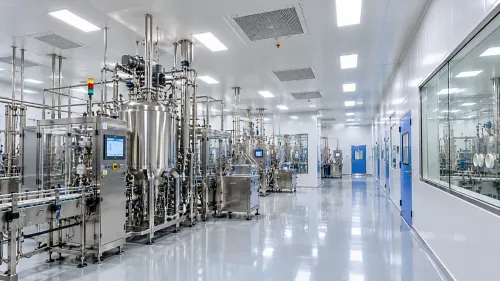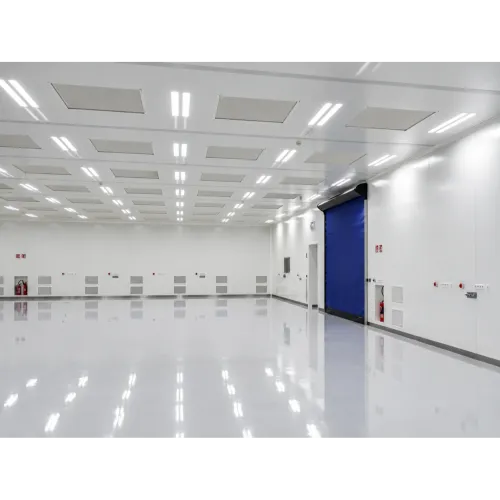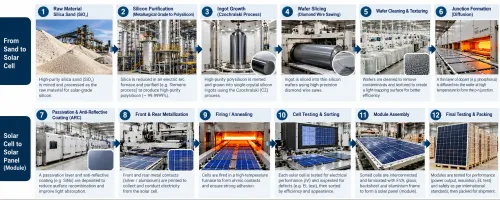

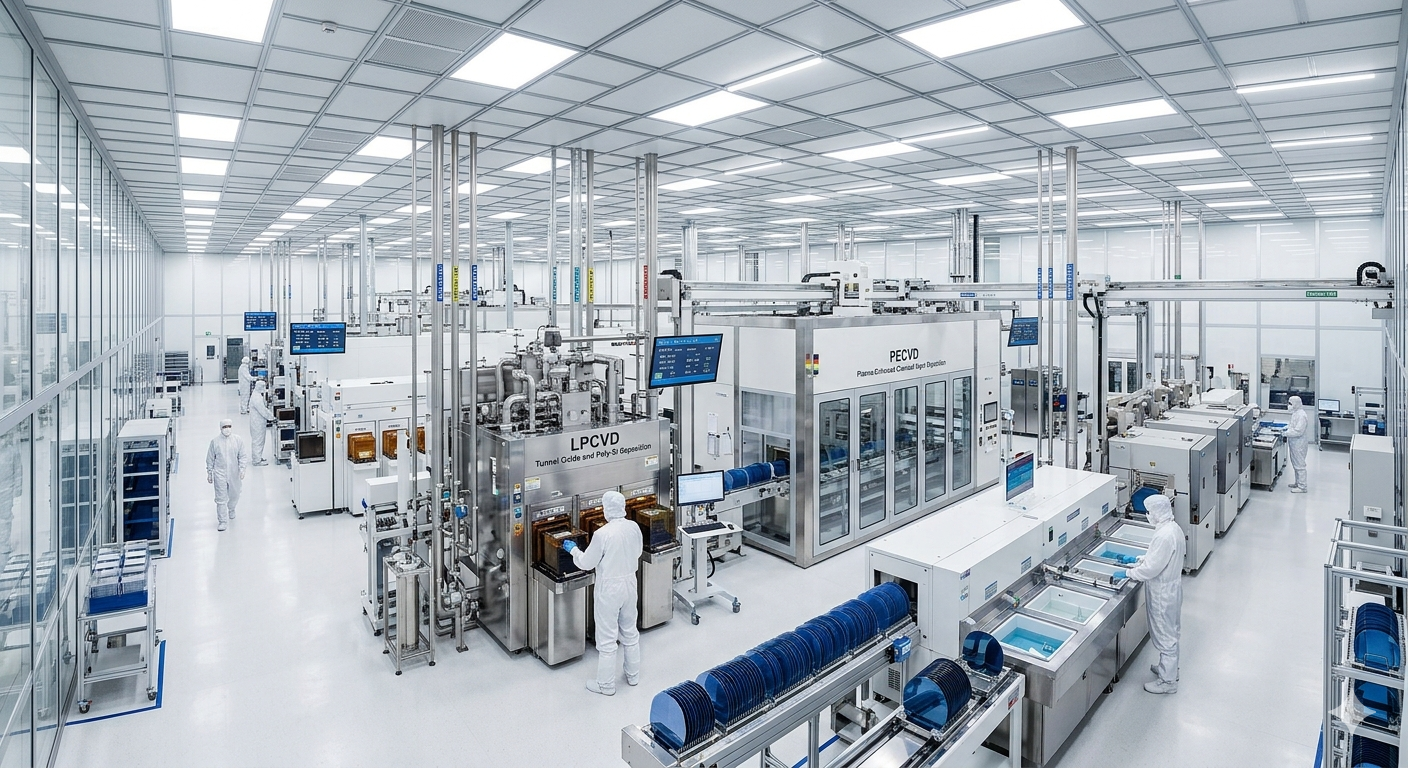
An efficient cleanroom design for TOPCon (Tunnel Oxide Passivated Contact) solar cell manufacture must be far more strict than ordinary silicon PV lines. TOPCon uses an ultra-thin tunneling oxide layer (~1.5 to 2.0 nm) with a doped polycrystalline silicon layer on the back side. Because even a single minute airborne particle or chemical vapor molecule can break the nanoscale tunnel oxide layer and reduce the cell's passivation performance, extremely sophisticated contamination controls are required.
1. Zoned Cleanroom Classifications for TOPCon
TOPCon fabrication lines use a modular, zoned architecture to balance stringent cleanliness with the high operational expenses of filtration.
- ISO Class 5 (Federal Standard Class 100) — Core Tunneling and Deposition: This is the most critical zone. The ultra-thin tunnel oxide layer (SiO₂) and subsequent n-type poly-Si deposition (using LPCVD or PECVD) must occur here.
- ISO Class 6 (Federal Standard Class 1,000) — Wet Chemical Cleaning and Texturing: Designed for initial RCA-style cleaning and high-temperature post-deposition annealing furnaces. Wafers must be fully clean before entering the oxide growth step.
- ISO Class 7 (Federal Standard Class 10,000) — Metallization and Screen Printing: Contains the fine-line silver (Ag) front paste printing and aluminum/silver rear paste printing systems.
- ISO Class 8 (Federal Standard Class 100,000) — Automated Testing and Sorting: Area for Laser Enhanced Contact Optimization (LECO) equipment, AAA solar simulation testing, and cell sorting.
2. Key Environmental and Contamination Controls
- Airborne molecular contamination (AMC) Filtration: Standard HEPA filters only capture physical particles. TOPCon facilities require specific Chemical Filters (Carbon/Ion-Exchange) within Fan Filter Units (FFUs). These remove trace gaseous impurities such as boron, phosphorus, and organic vapors, which might unintentionally counter-dope the very sensitive n-type silicon layer.
- Stringent Humidity Management: Maintain relative humidity between 40% and 50% (± 3%). Lower humidity increases the risk of electrostatic discharge (ESD), which degrades the nanometer-thin oxide layer, while higher humidity causes instantaneous wafer oxidation fluctuations and screen-printing paste performance concerns.
- Unidirectional laminar airflow: In ISO Class 5 and 6, airflow must move vertically downward from the ceiling at a uniform velocity (0.35 to 0.45 m/s) in order to force shedding particles away from open wafer cassettes immediately.
3. Key Manufacturing Equipment and Layout Integration:
When constructing the layout, unique machine parameters determine your cleanroom floor load and HVAC capacity.
- LPCVD vs. PECVD Footprint: LPCVD installations provide good film uniformity but require extensive heat management due to high-temperature quartz tubes, necessitating high-capacity Dry Cooling Coils (DCC). PECVD footprints are smaller and operate at lower temperatures, but they require extremely fine gas delivery control loops.
- Inline Automated Handling (FOUPs): To maintain high yields, current TOPCon lines use automated Front Opening Unified Pods (FOUPs), which are mini-isolated micro-environments that entirely separate wafers from ambient cleanroom air.