

Massive Dust-Holding Capacity: The Engineering Behind Filters That Outlast the Competition
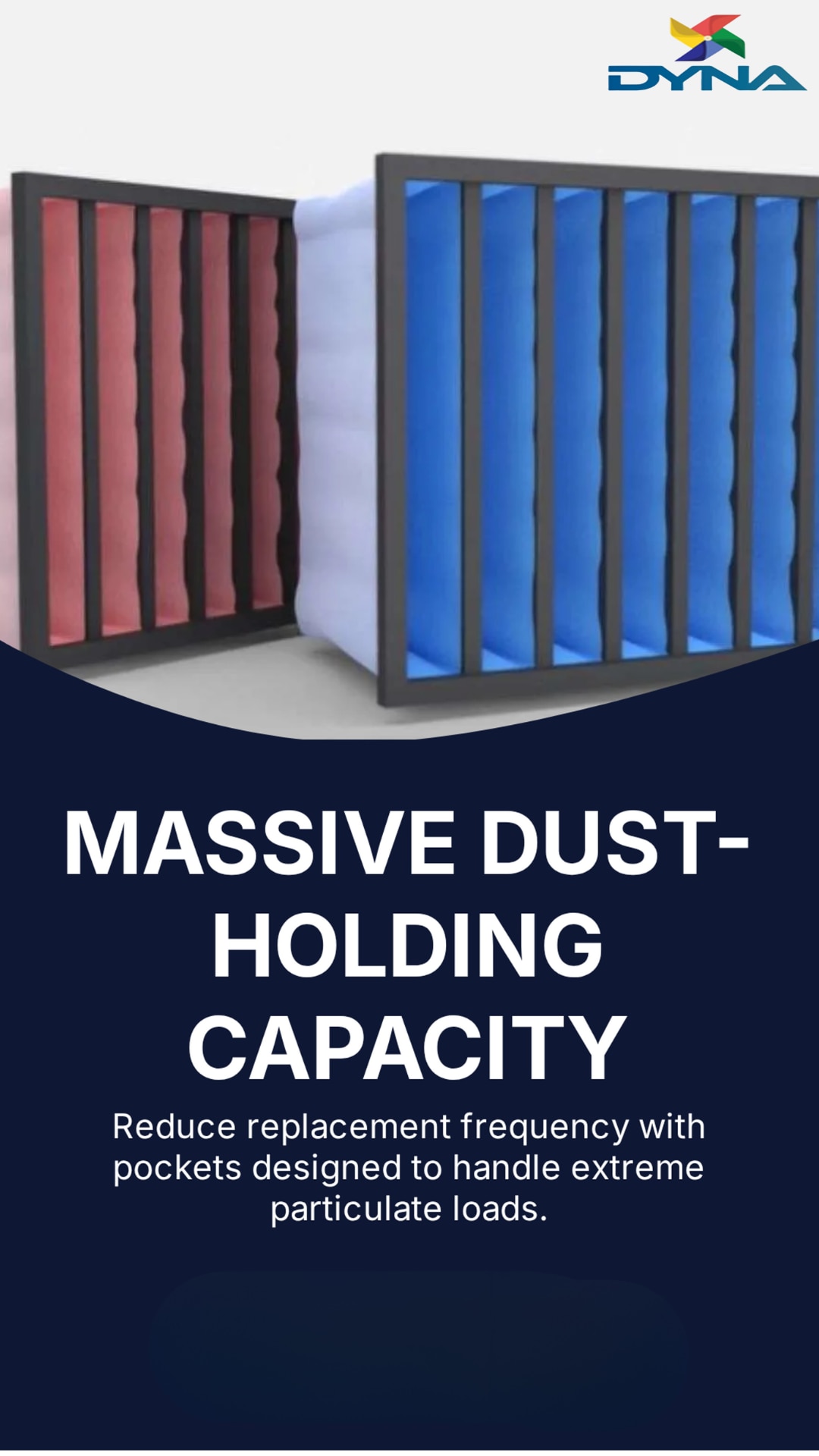
Reduce replacement frequency with pockets designed to handle extreme particulate loads.
In any facility running continuous airflow — a factory, warehouse, hospital, or commercial building — filters are working every second of every day. But not all filters age the same way. Some lose performance within weeks. Others, like Dyna Filters' pocket filters, are engineered specifically to handle massive particulate loads without frequent replacement. This post breaks down exactly why that matters, how it's achieved, and what it means for your facility's bottom line.
What Is Dust-Holding Capacity, Really?
Dust-holding capacity is a precise, measurable engineering value — typically expressed in grams of dust captured per filter — representing the total particulate mass a filter can trap and retain before its resistance to airflow (its pressure drop) reaches the manufacturer's specified final limit.
It's tested under controlled laboratory conditions, following international standards such as ISO 16890 and EN 779, where a filter is progressively loaded with a standardized synthetic dust until it reaches its rated final pressure drop — the point at which the filter is considered "spent" and must be replaced.
This is a fundamentally different measure from filtration efficiency, which tells you how well a filter captures particles at a single moment in time. Two filters can have identical efficiency ratings — say, both rated to capture 95% of particles at a given micron size — yet perform very differently over months of real-world use if their dust-holding capacities differ significantly.
Why Efficiency Alone Is a Misleading Metric
Here's the problem with judging a filter purely on its efficiency rating: a high-efficiency filter with low dust-holding capacity will saturate quickly under heavy particulate load. Once saturated:
- Airflow resistance rises sharply
- HVAC fans and blowers must work harder to maintain required airflow, consuming more energy
- Air quality can become inconsistent as the filter approaches its breaking point
- The filter must be replaced — often far sooner than facility teams expect
In practice, this means a facility might be replacing a "high-efficiency" filter every 3-4 weeks, not because the filtration technology failed, but because the filter simply ran out of room to hold dust.
A filter engineered for high dust-holding capacity solves this at the design level — not by lowering efficiency, but by fundamentally rethinking how much surface area is available to spread that particulate load across.
The Engineering Principle: Surface Area Changes Everything
This is where pocket (bag) filter architecture becomes critical. A standard flat-panel filter offers a single, limited plane of filtration media. All incoming particulate concentrates on that one surface, which is why flat filters tend to saturate relatively quickly under sustained particulate load.
Pocket filters solve this by extending the filtration media into multiple deep fabric pockets — typically between 4 and 8 pockets per filter unit, each often 300mm to 600mm in depth, depending on the model and application. This design can increase total available filtering surface area by 5 to 10 times compared to a flat panel filter occupying the identical frame footprint.
To put this in concrete terms: a standard 592mm x 592mm flat panel filter might offer roughly 1 to 2 square meters of total filtering surface. A pocket filter built to the same face dimensions — but with 6 to 8 deep pockets — can offer 8 to 12 square meters of usable filtering surface, all within the exact same installation space.
The practical result: incoming dust and particulate is distributed across a dramatically larger surface area instead of concentrating on one small plane. This slows the rate of saturation significantly, which is precisely why pocket filters achieve such high dust-holding capacity relative to their size.
Three Design Variables That Determine Real-World Performance
Not all pocket filters are engineered equally. The actual dust-holding capacity a filter delivers depends on how well three core variables are optimized together:
1. Pocket Depth
Deeper pockets create more usable surface area without requiring a larger frame. However, depth alone isn't the full story — pocket shape and spacing also affect how evenly airflow (and therefore particulate) is distributed across the media.
2. Filtration Media Selection
The choice between synthetic media and micro-glass fiber media involves a direct trade-off between particle-capture efficiency and airflow resistance. Media selected purely for maximum efficiency, without regard to airflow characteristics, can actually reduce dust-holding capacity by increasing resistance too quickly as dust accumulates.
3. Seam and Seal Integrity
This is often the most overlooked factor. Poorly sealed seams allow air to bypass the filtration media entirely — a phenomenon known as air bypass. Not only does this reduce actual filtration effectiveness (since bypassed air isn't filtered at all), it also causes uneven dust loading across the filter, which can shorten effective filter life even when the rated dust-holding capacity is high on paper.
Dyna Filters' pocket filters are engineered with all three variables optimized together — not treated as isolated specifications — which is what allows them to deliver genuinely extended service life under real operating conditions, not just in laboratory testing.
The Operational Math: What Extended Filter Life Actually Saves
Consider a facility running HVAC continuously, where a standard panel filter needs replacement every 4 to 6 weeks under typical particulate load. If a pocket filter engineered for high dust-holding capacity extends that interval to 3 to 4 months instead, the compounding operational impact looks like this over a single year:
- Labor costs drop substantially — filter changeouts require scheduled maintenance windows and technician time; extending intervals from monthly to quarterly can cut annual changeout labor by roughly 60-70%
- Material costs fall proportionally — fewer filters purchased annually directly reduces procurement spend
- Energy costs stabilize — because pressure drop rises more gradually and predictably over a longer service life, HVAC fans maintain more consistent power draw, rather than spiking sharply as a low-capacity filter approaches saturation
- Waste generation decreases — fewer filters disposed of per year supports sustainability targets, an increasingly important consideration for ISO-certified facilities and organizations tracking environmental impact metrics
Where High Dust-Holding Capacity Delivers the Most Value
Not every environment demands the same level of dust-holding performance, but certain facility types see outsized benefit from pocket filters engineered for extreme particulate loads:
- Manufacturing facilities — particularly those involving machining, packaging, material handling, or any process generating ambient dust and particulate
- Warehouses and logistics centers — high-traffic environments where vehicle movement and material handling create fluctuating, often heavy particulate levels
- Pre-filtration stages ahead of HEPA or ULPA filters — pocket filters positioned upstream capture coarser particulate before it reaches far more expensive final-stage HEPA filtration, significantly extending the service life of those downstream filters
- Large commercial HVAC systems — in buildings where filter housings are difficult to access, extending replacement intervals reduces both cost and logistical burden
- Pharmaceutical and healthcare cleanroom pre-filtration — where consistent air quality between changeouts is not just a cost consideration but a compliance requirement
Choosing Filters Based on Lifecycle Performance, Not Just a Spec Sheet
The core takeaway for procurement teams and facility managers is this: a filter's initial efficiency rating only tells part of the story. Dust-holding capacity determines how that efficiency actually holds up under sustained, real-world operating conditions — and it is frequently the single largest factor determining a filter's true total cost of ownership across a year of continuous use.
Dyna Filters' pocket filters are built around this understanding. Pocket depth, media selection, and seal integrity are engineered together, not in isolation, specifically to deliver filters capable of handling extreme particulate loads while maintaining stable, predictable performance across their entire service life — reducing replacement frequency without ever compromising on filtration quality.
Looking for the right filter specification for your facility's airflow and particulate conditions? Connect with Dyna Filters' technical team for a tailored recommendation based on your site's specific operating environment.
