

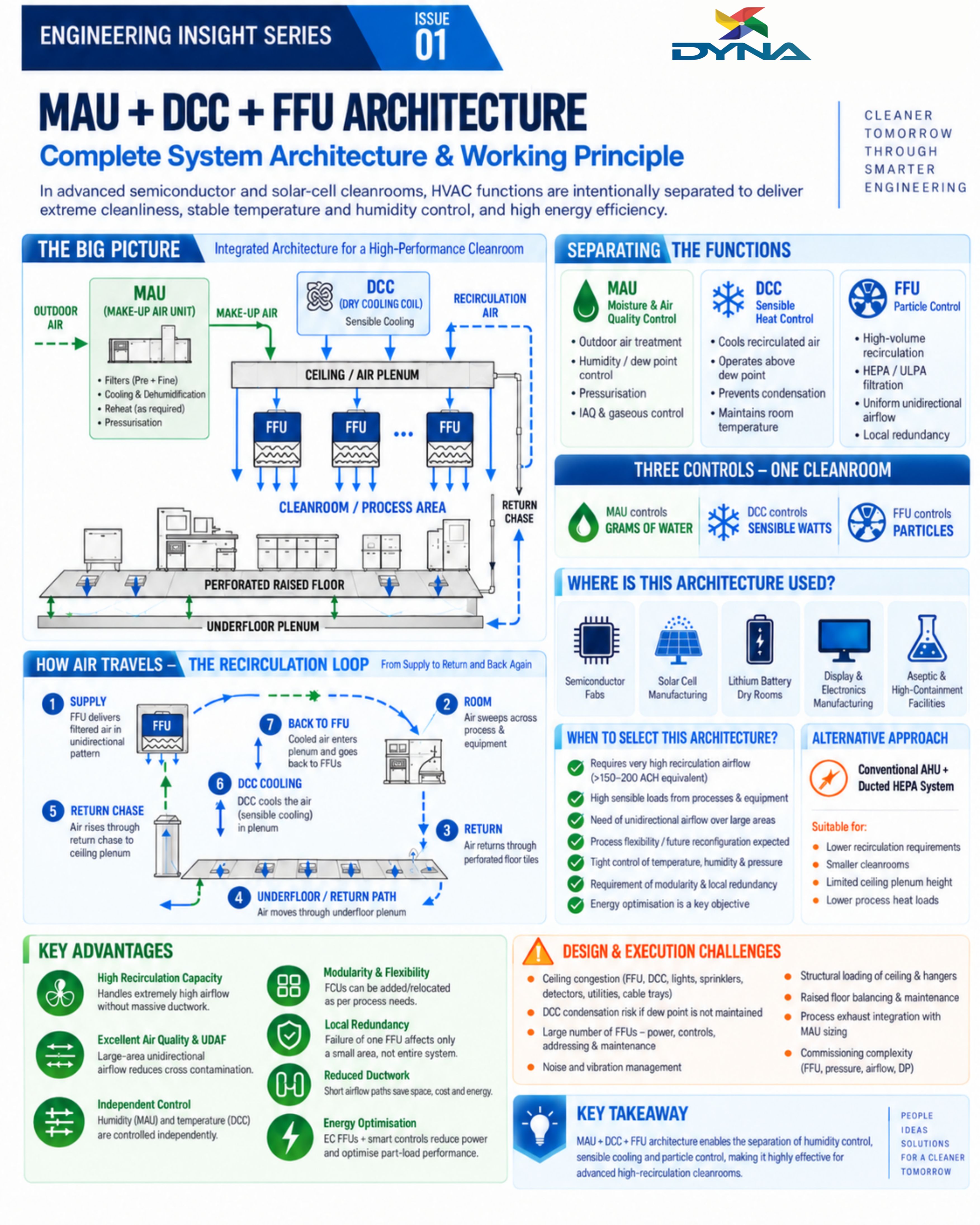
 Ask what keeps a cleanroom clean and most people say "HEPA filters." In advanced semiconductor, solar cell, lithium battery and electronics plants, filters are only one part of the answer. Temperature, humidity, pressure and airflow must be held just as tightly, while energy use stays under control.
One system trying to do all of this often falls short. So high-performance cleanrooms split the job among three specialists: the MAU, the DCC and the FFU. This guide explains what each one does, how air moves between them, what to watch for in design and commissioning, and when this architecture is the right choice.
Think of it as a team of three. The MAU manages moisture, the DCC manages temperature, and the FFU manages particles. Each one focuses on a single variable and does it very well.
In this guide: what a cleanroom must control, why conventional HVAC struggles at the high end, what each of the three systems does, how air travels through the loop, benefits and challenges, how to choose, commissioning and maintenance, common mistakes, a glossary and FAQs.
Why is cleanroom air so hard to control?
A cleanroom is more than a clean room. It is a controlled environment where several variables must stay inside tight limits at the same time:
- Airborne particles: cleanliness classes under ISO 14644-1 are defined by how many particles are allowed in a volume of air.
- Temperature: process tools, people and lighting all add heat, and many processes need stable temperatures to protect yield and product quality.
- Humidity and dew point: too much moisture can cause corrosion and defects, too little can cause static problems, and some processes, such as lithium battery manufacturing, need extremely low dew points.
- Room pressure: cleanrooms are usually kept at a higher pressure than surrounding areas, so contaminated air cannot leak in.
- Airflow pattern: in the most demanding zones, air should move in a smooth, uniform, unidirectional flow that carries particles away from the process instead of letting them swirl around it.
- Air quality: some processes also need control of gaseous and molecular contaminants.
These variables can pull against each other. Adding cooling can change humidity. Adding fresh air changes pressure. The MAU, DCC and FFU architecture gives the three biggest variables, which are moisture, heat and particles, a dedicated system each.
Why does conventional HVAC struggle in high-performance cleanrooms?
A conventional approach uses an Air Handling Unit (AHU) with ducted HEPA filters. It works very well for many cleanrooms. But as requirements rise, limits start to show:
- Very high recirculation airflow means very large air volumes. Moving them through a central AHU and long ducts needs big fans, large duct cross-sections and a lot of space.
- Large sensible heat loads from process tools put heavy cooling duty on the same unit that is also dehumidifying and filtering.
- Conflicting duties. A single coil is often asked to cool and dehumidify together. That can mean chilling air below its dew point and then reheating it, which wastes energy.
- Limited flexibility. Once ductwork is installed, changing the cleanroom layout later can be difficult and costly.
- Single points of failure. If a central fan or filter bank has a problem, a large area of the cleanroom can be affected.
This is why very demanding facilities separate the functions instead.
What is the MAU, DCC and FFU architecture?
It is a cleanroom HVAC architecture built from three specialized systems:
- MAU (Make-Up Air Unit): conditions outdoor air and controls humidity, pressurization and air quality.
- DCC (Dry Cooling Coil): removes sensible heat from the recirculated air.
- FFU (Fan Filter Unit): filters air through HEPA or ULPA filters and delivers it into the cleanroom.
A simple way to remember it: the MAU controls grams of water, the DCC controls sensible watts, and the FFUs control particles. Three controls, one cleanroom.
What does the MAU do?
The Make-Up Air Unit is the cleanroom's connection to the outside world. It brings in fresh outdoor air and prepares it before that air joins the recirculation loop.
What is inside a typical MAU?
- Pre and fine filters that remove most dust and particles from outdoor air
- Cooling and dehumidification to bring outdoor moisture down to the required level
- Reheat as required to reach the right supply temperature
- Fans and controls that deliver a stable, measured volume of make-up air
For very dry processes such as lithium battery dry rooms, desiccant-based dehumidification is commonly added alongside or instead of a conventional coil.
What is the MAU responsible for?
- Treating outdoor air
- Controlling humidity and dew point
- Pressurizing the cleanroom, so that air lost through process exhaust and leakage is replaced and positive pressure is kept
- Managing indoor air quality and gaseous contaminants
Why does the MAU matter so much?
Because the MAU sets the moisture level for the whole system, everything downstream becomes simpler. Make-up air is a much smaller volume than recirculated air, so drying only that stream is far more efficient than dehumidifying the entire recirculating airflow again and again.
What does the DCC do?
The Dry Cooling Coil cools the large stream of recirculated air. The word "dry" is the key. The coil works above the dew point of the air passing over it, so the coil surface never gets cold enough for moisture to condense.
What is the difference between sensible and latent heat?
Sensible heat is heat that changes the temperature of the air. Latent heat is the heat carried by moisture in the air. A dry coil removes only sensible heat. The moisture balance has already been set by the MAU, so the DCC can concentrate on temperature alone.
Where does the heat come from?
A cleanroom collects heat from process equipment, people, lighting and even the motors of the FFUs themselves. In high-performance facilities the sensible load can be very large. The DCC carries that heat away continuously without disturbing the humidity.
Are there other benefits?
Because a dry coil does not need to dehumidify, it can often be served by warmer chilled water than a dehumidifying coil would need. That can help chiller efficiency and, in some climates, open the door to free cooling. It also avoids the drainage and moisture concerns of a wet coil sitting inside the recirculation path.
What do FFUs do?
Fan Filter Units are the heart of the cleanroom's particle control. They are installed across the ceiling, and each one is a self-contained module.
What is inside a typical FFU?
- A fan and motor that draws air from the ceiling plenum. Many modern units use EC (electronically commutated) motors, which run efficiently and allow adjustable speed.
- A HEPA or ULPA filter that removes particles before air enters the room.
- A housing and diffuser that spreads the clean air evenly.
- Controls for speed adjustment, monitoring and integration with a central system.
How good are HEPA and ULPA filters?
Filters are graded by how well they capture the most penetrating particle size (MPPS), which is the hardest size to catch. An H14 HEPA filter captures at least 99.995% of particles at that size, and a U15 ULPA filter captures at least 99.9995%. Higher grades are used where processes are more sensitive to very fine particles.
What do FFUs deliver?
- High-volume recirculation: many units working in parallel move very large amounts of air.
- Uniform unidirectional airflow: clean air flows down in a smooth, even pattern that carries particles away from the process.
- Local redundancy: if one FFU fails or needs service, only a small area is affected, not the whole cleanroom.
- Flexibility: FFUs can be added, moved or re-balanced as processes change.
Why split the work?
When a single system must cool, dehumidify and filter, its goals often conflict. A conventional coil may chill air below its dew point to remove moisture, then reheat it to reach the right temperature. That uses extra energy and makes precise control harder.
With the split design:
- The MAU dries only the small stream of make-up air.
- The DCC cools the large recirculated stream without adding a moisture load.
- The FFUs handle the high-volume airflow and filtration.
Each system can be sized, controlled and optimized for one job. The result is tighter control, stable conditions and better energy performance.
What does the physical layout look like?
The architecture relies on a specific layout:
- Ceiling or air plenum: a space above the cleanroom ceiling that holds recirculated air and conditioned make-up air. The FFUs draw from this plenum.
- Cleanroom or process area: the space where equipment sits and filtered air flows downward.
- Perforated raised floor: a floor of perforated tiles that lets air pass down into the space below.
- Underfloor plenum: the space under the raised floor where air travels toward the return path.
- Return chase: a vertical path, usually along the edge of the cleanroom, through which air rises back to the ceiling plenum.
Together these form a continuous loop. The same air is filtered again and again, cooled by the DCC and topped up with conditioned make-up air from the MAU.
How does the air move?
Follow one breath of air around the loop:
- Supply: FFUs push filtered air down in a unidirectional pattern.
- Room: it sweeps across the process and equipment, carrying particles away.
- Return: it leaves through the perforated raised floor tiles.
- Underfloor path: it travels through the underfloor plenum.
- Return chase: it rises to the ceiling plenum.
- DCC cooling: the DCC removes sensible heat from the air in the plenum.
- Back to the FFUs: cooled air, mixed with conditioned make-up air from the MAU, returns to the FFUs and the loop repeats.
On every pass, the FFU filters remove particles, the DCC removes heat, and the MAU keeps the moisture level steady.
How do the three systems stay in sync?
Three systems working as one need good controls:
- MAU controls hold the dew point, make-up air volume and room pressurization.
- DCC controls regulate chilled water flow to hold room temperature, while keeping coil conditions above the dew point.
- FFU controls allow individual or grouped speed adjustment, so airflow can be balanced across the ceiling and raised or lowered as needed.
- Sensors for temperature, humidity or dew point, differential pressure and airflow feed a central building management or cleanroom control system.
With individually addressable FFUs, operators can monitor performance, spot a failing unit early and adjust airflow for different process conditions.
What are the benefits?
- High recirculation capacity: very high airflow without massive ductwork.
- Excellent air quality: large-area unidirectional airflow reduces cross-contamination.
- Independent control: humidity (MAU) and temperature (DCC) can be tuned separately.
- Modularity and flexibility: FFUs can be added or moved as process needs change.
- Local redundancy: one FFU failing affects only a small area, and units can often be serviced without shutting down the whole cleanroom.
- Reduced ductwork: short airflow paths save space, cost and energy.
- Energy optimization: EC FFUs and smart controls cut power use and improve part-load performance, while the dry coil avoids needless dehumidification and reheat of the recirculated air.
- Scalability: new bays can be added using the same architecture as production grows.
What should you plan for?
A good design deals with these from day one:
- Ceiling congestion: FFUs, DCC, lights, sprinklers, detectors, utilities and cable trays all compete for ceiling space, so early coordination between disciplines matters.
- Condensation risk: the DCC must stay above the dew point. If the dew point rises, the "dry" coil can start to condense, which makes MAU humidity control critical.
- Large FFU count: power distribution, controls, addressing and maintenance need careful planning, especially in big cleanrooms with hundreds of units.
- Noise and vibration: many fans running together must be managed through good selection, mounting and balancing.
- Structural loading: the ceiling grid and hangers carry significant weight.
- Raised floor: it needs balancing and ongoing maintenance.
- Process exhaust: exhaust volumes must be built into MAU sizing so pressurization holds.
- Commissioning complexity: FFUs, pressure, airflow and differential pressure interact, so they must be commissioned together.
How does it compare with AHU plus ducted HEPA?
Recirculation airflow
- MAU, DCC and FFU: suited to very high recirculation.
- AHU with ducted HEPA: suited to lower recirculation.
Ductwork
- MAU, DCC and FFU: reduced, with short airflow paths.
- AHU with ducted HEPA: more extensive.
Humidity and temperature control
- MAU, DCC and FFU: controlled independently by the MAU and DCC.
- AHU with ducted HEPA: typically handled by the same coil.
Flexibility
- MAU, DCC and FFU: FFUs can be added or relocated.
- AHU with ducted HEPA: layout changes are harder once ducting is installed.
Redundancy
- MAU, DCC and FFU: local, since one FFU affects only a small area.
- AHU with ducted HEPA: a central unit problem can affect a larger area.
Ceiling plenum height
- MAU, DCC and FFU: needs enough space for FFUs, DCC and services.
- AHU with ducted HEPA: can work where plenum height is limited.
Best suited for
- MAU, DCC and FFU: large, high-heat, high-recirculation cleanrooms.
- AHU with ducted HEPA: smaller cleanrooms with lower heat loads.
Neither is better in every case. The right choice depends on the project.
When is it the right choice?
Choose the MAU, DCC and FFU architecture when your project needs:
- Very high recirculation airflow (above 150-200 ACH equivalent)
- High sensible loads from processes and equipment
- Unidirectional airflow over large areas
- Process flexibility and future reconfiguration
- Tight control of temperature, humidity and pressure
- Modularity and local redundancy
- Energy optimization as a key objective
A conventional AHU with ducted HEPA still suits lower recirculation requirements, smaller cleanrooms, limited ceiling plenum height and lower process heat loads.
A quick selection checklist
- Define the required cleanliness class and airflow pattern for each area.
- Estimate the sensible heat load from equipment, people and lighting.
- Set the humidity or dew point requirement and the make-up air needed.
- Check available ceiling plenum height and structural capacity.
- Think about how often the layout may change.
- Compare energy use at full and part load.
- Decide how much redundancy critical areas need.
If most answers point to high airflow, high heat and flexibility, this architecture deserves serious consideration.
Where is it used?
- Semiconductor fabs: processes are extremely sensitive to particles, temperature and humidity, and tools change often, so large-area unidirectional airflow and easy reconfiguration are valuable.
- Solar cell plants: large production areas need clean, stable conditions, and modular FFU layouts help cool heat-generating equipment efficiently.
- Lithium battery dry rooms: very low humidity protects moisture-sensitive materials. Because the MAU controls moisture separately, the humidity strategy can be built around the dry-room target while the DCC and FFUs handle heat and cleanliness.
- Electronics and display factories: fine features are easily damaged by particles, so uniform airflow and precise temperature control protect quality.
- Pharmaceutical and aseptic facilities: critical areas benefit from unidirectional airflow, local redundancy and tight pressure and temperature control.
How is the system commissioned and tested?
A well-designed system still has to be proven on site. Typical steps include:
- Airflow and velocity checks across the FFU ceiling to confirm uniform flow
- Filter leak (integrity) testing to confirm HEPA and ULPA filters and their seals are intact
- Airborne particle counts to confirm the required cleanliness class
- Differential pressure checks between cleanroom zones and surrounding areas
- Temperature and humidity mapping to confirm stable conditions across the space
- Balancing of the raised floor and return path
- Controls verification, including alarms, interlocks and MAU, DCC and FFU coordination
Many of these test methods are described in the ISO 14644 series. Because the three systems interact, commissioning works best when they are tuned together, not one at a time.
How do you maintain it?
- FFU filters: watch pressure drop, replace as needed and keep spares on hand.
- FFU fans and motors: replace units showing unusual noise, vibration or speed drift.
- DCC coils: keep coil surfaces clean and check chilled water flow and temperature.
- MAU filters and coils: replace pre and fine filters on schedule and inspect coils, dampers and reheat.
- Raised floor and return path: keep the underfloor plenum clean and tiles correctly placed.
- Sensors: calibrate temperature, humidity, dew point and pressure sensors regularly, because the whole control strategy depends on them.
- Re-testing: repeat leak tests and particle counts at set intervals.
What mistakes should you avoid?
- Underestimating ceiling congestion and finding clashes only at installation
- Letting the dew point rise and causing condensation on the DCC
- Undersizing the MAU by forgetting process exhaust
- Ignoring the structural load of the ceiling grid and hangers
- Treating FFU control as an afterthought, leaving no way to monitor or balance units
- Commissioning each system separately instead of tuning all three together
- Giving up future flexibility, which is one of the biggest advantages of the design
Glossary of key terms
- ACH (Air Changes per Hour): how many times a room's air volume is replaced or recirculated in an hour.
- Dew point: the temperature at which moisture in the air starts to condense.
- DCC (Dry Cooling Coil): a cooling coil operated above the dew point, removing only sensible heat.
- EC motor: an electronically commutated motor with efficient, adjustable-speed operation.
- FFU (Fan Filter Unit): a self-contained module with a fan and a HEPA or ULPA filter.
- HEPA filter: a high-efficiency particulate air filter.
- Latent heat: heat associated with moisture in the air.
- MAU (Make-Up Air Unit): a unit that conditions outdoor air before it enters the cleanroom system.
- MPPS: most penetrating particle size, used to grade filter efficiency.
- Plenum: an air space, such as above the ceiling or under the raised floor, used to distribute or return air.
- Sensible heat: heat that changes the temperature of the air.
- Unidirectional airflow: smooth, uniform airflow in one direction that sweeps particles away from the process.
- ULPA filter: an ultra-low penetration air filter for the highest levels of particle removal.
Frequently asked questions
What does MAU, DCC and FFU stand for?
MAU is Make-Up Air Unit, DCC is Dry Cooling Coil, and FFU is Fan Filter Unit. Together they control moisture, heat and particles independently in a cleanroom.
What is the difference between a dry cooling coil and a normal cooling coil?
A dry cooling coil works above the dew point, so it removes only sensible heat and produces no condensation. A conventional coil often cools below the dew point to remove moisture as well.
Why must the DCC stay above the dew point?
If the coil surface drops below the dew point, moisture condenses on it. The DCC is meant for sensible cooling only, so the MAU must hold the dew point steady.
Why use FFUs instead of a ducted HEPA system?
FFUs suit cleanrooms that need very high recirculation, large-area unidirectional airflow, modularity and local redundancy, with short airflow paths and less ductwork. Ducted HEPA remains a good fit for smaller rooms with lower airflow and heat loads.
What happens if one FFU fails?
Airflow is spread across many units, so one failure affects only a small local area. That local redundancy is a key reliability advantage.
Can FFUs be added or moved later?
Yes. Modularity is a main advantage, but ceiling capacity, power, controls and airflow balance should be reviewed first.
What are EC FFUs?
EC FFUs use electronically commutated motors, which run efficiently at adjustable speeds. With smart controls, they help cut power use and improve part-load performance.
What does the MAU do in a cleanroom?
It treats outdoor air, controls humidity and dew point, supplies make-up air for pressurization and process exhaust, and helps manage air quality and gaseous contaminants.
Which industries use this architecture?
Semiconductor fabs, solar cell plants, lithium battery dry rooms, electronics and display factories, and pharmaceutical and aseptic facilities.
When should I choose AHU with ducted HEPA instead?
When recirculation needs are lower, the cleanroom is smaller, ceiling plenum height is limited or process heat loads are lower.
Key takeaway
Splitting humidity control, sensible cooling and particle control lets each system do one job well. That is why the MAU, DCC and FFU architecture suits advanced, high-recirculation cleanrooms, with precise control, flexibility, local redundancy and better energy performance.
Planning a cleanroom project? Talk to Dyna Filters
Dyna Filters supplies HEPA, ULPA, pre and fine filters, FFUs, laminar airflow systems, cleanroom panels, pass boxes, air showers and HVAC filtration solutions. Talk to our team about your cleanroom requirements.
