
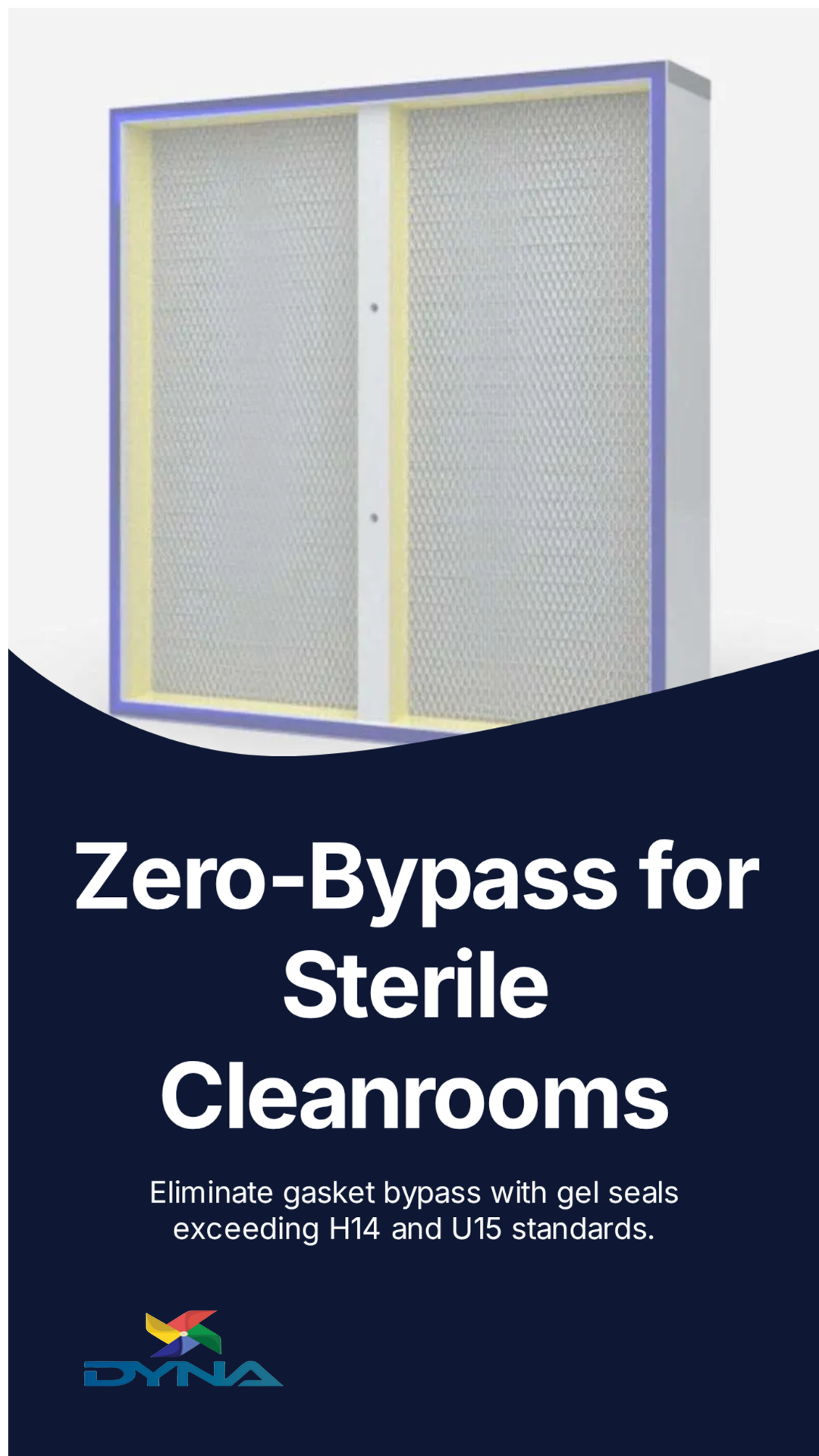
Eliminate gasket bypass with gel seals exceeding H14 and U15 standards.
In sterile environments — pharmaceutical manufacturing, hospital operating theatres, semiconductor cleanrooms — filtration efficiency is only half the equation. A filter can be rated to capture 99.999% of particles down to 0.3 microns and still fail to protect a cleanroom if air is leaking around its edges instead of passing through the filtration media itself. This is the problem of gasket bypass, and it's precisely what Dyna Filters' Gel HEPA filters are engineered to eliminate.
What Is Gasket Bypass, and Why Does It Matter?
Every HEPA filter installation relies on a seal between the filter frame and its housing to ensure that 100% of airflow passes through the filtration media — not around it. Traditional filters typically use a compressible foam or rubber gasket, mechanically pressed against the housing frame to create this seal.
The problem is that mechanical gasket seals are vulnerable to imperfections. Minor warping in the housing, uneven mounting pressure, gasket compression set over time, or even small manufacturing tolerances can create microscopic gaps. Air — and the particulate it carries — will always follow the path of least resistance. Even a tiny gap in a gasket seal allows unfiltered air to bypass the HEPA media entirely, undermining the filter's actual protective performance regardless of how high its rated efficiency is on paper.
In a sterile cleanroom, this isn't a minor inefficiency — it's a direct contamination risk. A single point of bypass can compromise an entire controlled environment, which is why regulatory standards for cleanroom filtration place as much emphasis on installation integrity as they do on filtration efficiency itself.
How Dyna Gel Seal Technology Solves This
Gel HEPA filters replace the traditional mechanical gasket with a Dyna gel seal system. Instead of relying on compression against a foam gasket, the filter frame contains a channel filled with a specialized gel compound. During installation, a knife-edge on the housing frame is pressed directly into this gel channel, creating a continuous, self-conforming seal around the entire perimeter of the filter.
Because the gel flows to conform precisely around the knife-edge — rather than depending on uniform mechanical pressure across a solid gasket — it fills microscopic imperfections and irregularities in the housing that a traditional gasket simply cannot compensate for. The result is a genuinely continuous seal, free of the small gaps that cause bypass in conventional installations.
This is why Dyna gel-sealed filters are specified as the standard for the most demanding sterile applications, where even minimal bypass risk is unacceptable.
Understanding H14 and U15 Standards
HEPA and ULPA filter classifications are defined under EN 1822, the European standard governing high-efficiency particulate air filtration. Under this standard:
- H14 filters are rated to capture at least 99.995% of particles at their Most Penetrating Particle Size (MPPS)
- U15 (ULPA-class) filters exceed this further, rated to capture at least 99.9995% of particles at MPPS
These classifications describe the filtration media's efficiency — but a filter's real-world protective performance also depends entirely on installation integrity. A H14-rated filter with gasket bypass can perform significantly worse in practice than its rating suggests, because a portion of the airflow is skipping the media altogether. Dyna Filters' Gel HEPA filters are engineered to exceed H14 and U15 standards while also eliminating the bypass risk that can undermine even a highly-rated filter in the field — closing the gap between rated performance and actual protective performance.
Where Zero-Bypass Filtration Is Essential
Dyna's Gel-sealed HEPA filtration is specified in environments where sterility failures carry serious consequences:
- Pharmaceutical manufacturing cleanrooms, where airborne contamination can compromise entire production batches
- Hospital operating theatres, where surgical site infection risk is directly tied to air quality control
- Semiconductor and electronics cleanrooms, where even microscopic particulate contamination can cause product failure
- Biotechnology and research laboratories, where controlled, verifiable air quality is a regulatory requirement, not a convenience
Engineering Confidence Into Every Installation
For facility engineers and procurement teams specifying filtration for sterile environments, the takeaway is straightforward: filtration efficiency ratings only tell part of the story. Installation integrity — specifically, the elimination of gasket bypass — is what determines whether a filter's rated performance translates into real protection.
Dyna Filters' Gel HEPA filters are engineered specifically to close this gap, combining H14 and U15-exceeding filtration media with a gel seal system that ensures the filter performs exactly as rated, with zero tolerance for bypass.
Specifying filtration for a sterile or cleanroom environment? Connect with Dyna Filters' technical team to find the right gel-sealed HEPA solution for your facility's compliance requirements.