
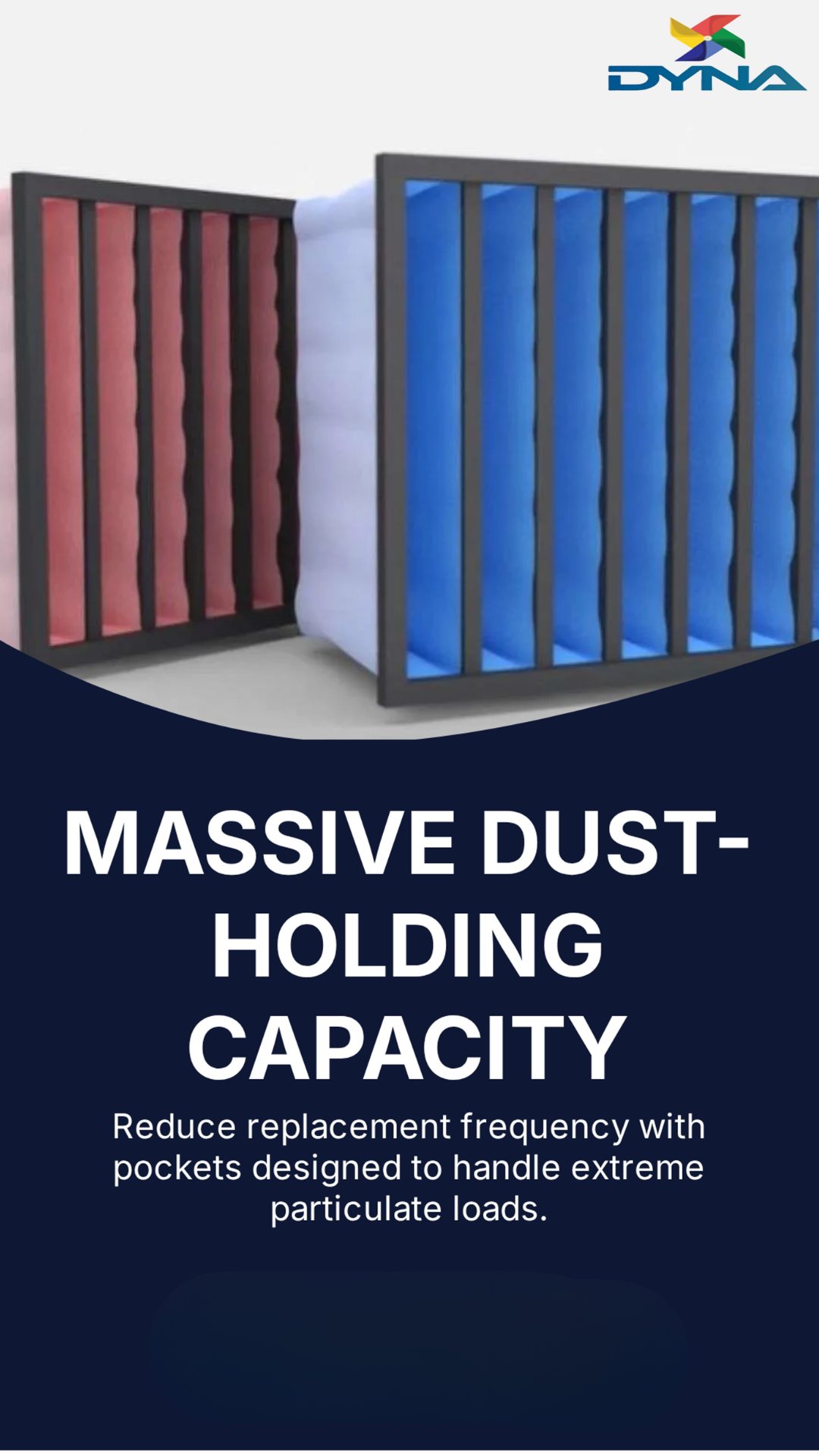
Maximizing Dust-Holding Capacity: Why Pocket Filter Design Determines Your Total Cost of Filtration
When facilities evaluate air filtration options, the conversation often centers on initial efficiency ratings — how well a filter captures particles on day one. But for operations managing continuous airflow and high particulate loads, a more important question determines long-term cost and performance: how much dust can the filter actually hold before it needs replacing? This is where Dyna Filters' pocket filter range is engineered to stand apart, with dust-holding capacity built directly into the pocket architecture.
What Dust-Holding Capacity Actually Means
Dust-holding capacity refers to the total mass of particulate matter a filter can capture and retain over its service life before airflow resistance rises to the point where the filter must be replaced. A filter with low dust-holding capacity fills up quickly — even if its initial efficiency rating is high — leading to frequent replacements, more waste, and higher long-term operating costs. A filter engineered for high dust-holding capacity, by contrast, continues performing reliably even as particulate accumulates, extending the interval between replacements significantly.
This distinction matters enormously in real-world conditions. Two filters with identical efficiency ratings on a test bench can perform very differently once installed in a facility with continuous, high-volume airflow and variable particulate loads.
How Pocket Design Increases Dust-Holding Capacity
The pocket (bag) filter format is specifically engineered to maximize dust-holding capacity within a compact footprint. By extending filtration media into multiple deep fabric pockets rather than a single flat plane, the filter dramatically increases its total surface area. More surface area means particulate matter is distributed across a much larger filtering surface, rather than concentrating and clogging a small area quickly.
Dyna Filters' pocket filters are constructed with this principle at the core of their design — pocket depth, media selection, and stitching quality are all optimized to ensure the filter can accumulate a substantial dust load while maintaining stable airflow and structural integrity. The result is a filter built to handle extreme particulate loads without premature saturation.
Why This Matters for Facility Operations
For facilities operating continuously — manufacturing plants, warehouses, commercial HVAC systems, and pre-filtration stages ahead of HEPA units — replacement frequency is a direct operational cost. Every filter change involves labor, material cost, and often a brief interruption to normal airflow management. Filters with poor dust-holding capacity multiply these costs over a year of operation.
By contrast, a pocket filter engineered for high dust-holding capacity:
Extends the interval between filter replacements, reducing labor and material costs
Maintains more stable pressure drop over its service life, keeping HVAC energy consumption predictable
Reduces the frequency of operational disruption caused by filter changeouts
Lowers the total volume of filter waste generated per year, supporting sustainability goals
Built for Facilities That Can't Afford Frequent Downtime
In industries where airflow must remain continuous — pharmaceutical manufacturing, food processing, electronics assembly, and large-scale commercial buildings — an underperforming filter isn't just an inconvenience. It's a recurring operational cost and a potential compliance risk if air quality standards aren't consistently maintained between changeouts.
Dyna Filters' pocket filter range is designed with this operational reality in mind. Rather than optimizing purely for initial efficiency numbers, our engineering team focuses on how the filter performs across its entire service life — from first installation to the point of replacement — ensuring consistent particulate capture and airflow performance throughout.
Choosing Filters Based on Lifecycle Performance, Not Just Specifications
For procurement and facilities teams, the key takeaway is this: a filter's true value isn't captured by its initial efficiency rating alone. Dust-holding capacity is what determines how that efficiency holds up under real operating conditions — and ultimately, how much a filtration solution actually costs a facility over a year of use.
Dyna Filters' pocket filters are engineered specifically to perform under extreme particulate loads, giving facilities a filtration solution that reduces replacement frequency without compromising on air quality or airflow efficiency.
To find the right pocket filter specification for your facility's particulate load and airflow requirements, connect with our technical team for a tailored recommendation.