
Dyna Engineering Insight Series | Issue 01
Modern manufacturing is pushing cleanroom requirements higher every year. Semiconductor, solar cell, lithium battery, electronics and pharmaceutical facilities all need extreme cleanliness, stable temperature, tight humidity control and low energy use at the same time. A single conventional HVAC system struggles to balance all of these.
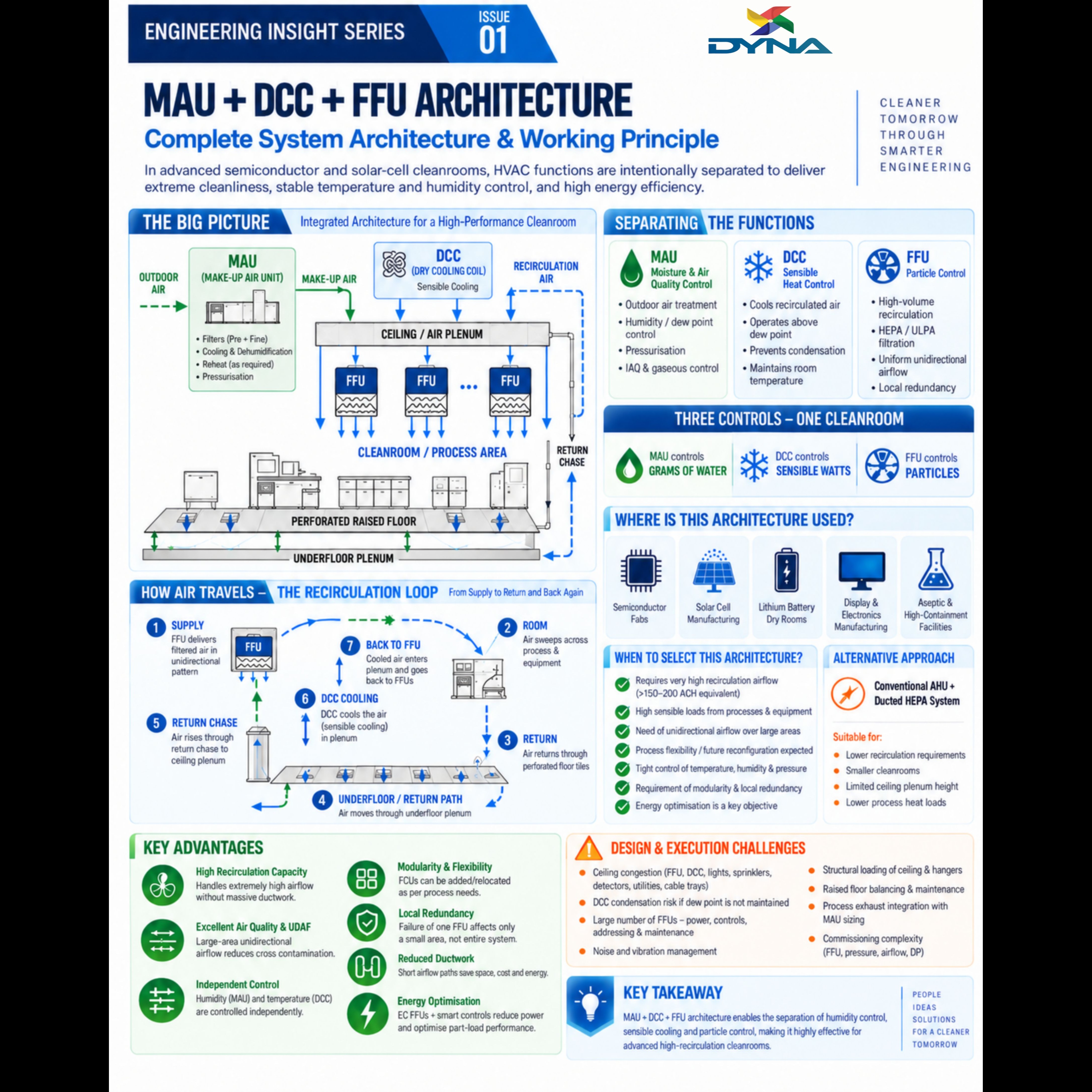
The MAU + DCC + FFU architecture solves this by deliberately separating the HVAC functions, so each system controls one variable: moisture, heat or particles.
What Is MAU + DCC + FFU Architecture?
Three specialized systems work together:
MAU (Make-Up Air Unit): conditions outdoor air and controls humidity, pressurization and air quality.
DCC (Dry Cooling Coil): removes sensible heat from the recirculated air.
FFU (Fan Filter Unit): filters air through HEPA or ULPA filters and delivers it into the cleanroom.
Remember it this way: the MAU controls grams of water, the DCC controls sensible watts, and the FFUs control particles. Three controls, one cleanroom.
The Three Core Components
MAU: Moisture and Air Quality Control
The MAU treats outdoor air before it enters the recirculation loop, using pre and fine filtration, cooling and dehumidification, and reheat as required. For very low humidity processes such as lithium battery dry rooms, desiccant-based dehumidification is commonly added. It controls humidity and dew point, pressurizes the cleanroom and manages air quality and gaseous contaminants. Because it handles the moisture of the whole system, everything downstream becomes simpler.
DCC: Sensible Heat Control
The DCC cools the large recirculated air stream while operating above the dew point, so no condensation forms. It removes only sensible heat from process equipment, people, lighting and FFU motors, leaving the humidity set by the MAU untouched.
FFU: Particle Control
Fan Filter Units are installed across the ceiling, each with a fan and a HEPA or ULPA filter. For example, an H14 HEPA filter captures at least 99.995% of particles at the most penetrating particle size. Many units working in parallel deliver high-volume recirculation and uniform unidirectional airflow, with local redundancy if one unit fails.
Why Separate Humidity, Temperature and Particle Control?
When one system must cool, dehumidify and filter, its goals conflict. A conventional coil may cool air below its dew point to remove moisture, then reheat it, which wastes energy. By separating the functions, the MAU dehumidifies only the small make-up air volume, the DCC cools the large recirculated stream without a moisture load, and the FFUs handle airflow and filtration. The result is better process control, higher stability and improved energy performance.
How Air Travels: The Recirculation Loop
Supply: FFUs deliver filtered air in a unidirectional pattern.
Room: Air sweeps across the process and equipment, carrying particles away.
Return: Air leaves through the perforated raised floor.
Underfloor path: Air moves through the underfloor plenum.
Return chase: Air rises to the ceiling plenum.
DCC cooling: The DCC removes sensible heat.
Back to the FFUs: Cooled air, mixed with MAU make-up air, returns to the FFUs and the loop repeats.
Key Advantages
High recirculation capacity without massive ductwork
Independent humidity (MAU) and temperature (DCC) control
Modular: FFUs can be added or relocated
Local redundancy: one FFU failing affects only a small area
Energy optimization with EC FFUs and smart controls
Design and Execution Challenges
Ceiling congestion and structural loading
Condensation risk if dew point is not maintained
Power, controls and maintenance for many FFUs
Noise, vibration and raised floor balancing
Process exhaust integration with MAU sizing
Commissioning of FFUs, pressure and airflow together
When to Select This Architecture
Choose it for very high recirculation airflow (above 150–200 ACH equivalent), high sensible loads, unidirectional airflow over large areas, tight temperature, humidity and pressure control, future reconfiguration and energy optimization. A conventional AHU with ducted HEPA system remains suitable for lower recirculation, smaller cleanrooms, limited ceiling plenum height and lower process heat loads.
Key Takeaway
MAU + DCC + FFU separates humidity control, sensible cooling and particle control, making it highly effective for advanced, high-recirculation cleanrooms.
Planning a Cleanroom Project? Talk to Dyna Filters
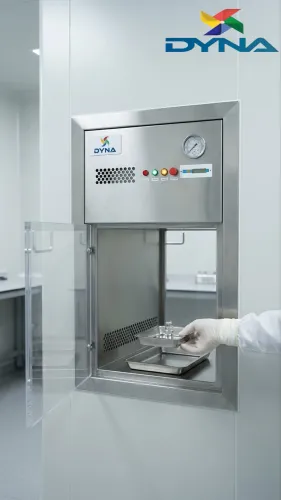
Dyna Filter Pvt. Ltd. manufactures and supplies HEPA, ULPA, pre and fine filters, FFUs, laminar airflow systems, cleanroom panels, pass boxes, air showers and HVAC filtration solutions. Contact our team to discuss your cleanroom requirements.